


Morning Musing on The Aging Dancer
Luvlies, Good morning. I just finished the documentary When the Body Says Stop, which highlights what happens to a dancer who is close to, or at the early stages of retirement. And I have some thoughts…
Culturally, this appears to be a European issue, specifically White Europeans, and their lack of opportunities for the dance community once their professional careers have ended. Maybe it’s just limited to ballet and contemporary. Maybe it’s because Europeans are not known to express their joy or communicate with one another through dance as a medium. I don’t know…
Professional dancers aim for a handful of spots on a limited amount of stages. Think of a basketball player who only wants to play in the NBA. They will definitely fail. The are many lucrative lower leagues, where people perform at the highest level for years; they just might not have played the politics to get to the NBA, but they’re still playing ball professionally.
Many of these dancers will have a bigger shock when they realize the system they went through in dance is more political than they understood it to be. Who was your teacher? What dance school did you attend? Which competitions did you win? It’s all politics to filter out even the best dancers from a career in dance. Sorry to this man, but the old system of dance is dead, and the dancers featured in the documentary realized that.
Traditional dance programs have always been a dead-end for many, but there are schools, such as PARTS or Carnegie Mellon, that prepare you to work in the field, in different capacities of the performing arts.
Yes, you have the traditionalists who want to uphold the system, but you have more and more anarchists/outliers present in the dance world. Thanks to their social media presence, they’re bypassing and thriving in the dance universe by controlling their own narrative. They might not aim to be part of the company cosmos, but they are being contracted to dance professionally.
Some of my favourites dance rebels are Maddie Woo, Luna Montana, Isabella McGuire Mayes and Lori Hernandez.
But in North America, we treasure our most beloved stage performers (just not our celebrities lol). We love it if our dance legends still strut their stuff on stage. Alvin Ailey, Judith Jameison, Martha Graham, Merce Cunningham, Gregory Hines, Natalia (Natasha) Makarova, Mikhail Baryshnikov, Luigi, Fossi, Fred Astaire, all performed well into old age.
Within Black & Latinx culture, you can dance professionally in your elder years. Black churches have praise dance troupes that rival any ballet company (with people of all ages), that travel the country to perform.
Latin America & the spanish speaking parts of the US, put no age limits on their cultural dance communities (Salsa, Meringe, Bachata, Tango, etc.) They have festivals circuits that we outsiders don’t know about. Trinidad Carnival (and Brazil Carnival) is where people of every age dress in full costume to perform every year.
In Rio de Janeiro, there are Samba tryouts for their drum cores bands and numerous (highly competitive) Samba schools all over the city. Again, no age limits when it comes to ‘shakin’ what yo mama gave ya’.
Don’t get it twisted. They are all being paid to dance.
One of the dancers in the documentary said ‘that contemporary dancers have a better connection to their bodies’ which is why their careers are longer. I think that can be expanded upon:
Contemporary dancers have a better connection with the real world. There’s more canon for the contemporary dance community to pull from, not just storybook fantasy narratives that ballet world is in.
On the flip side, a retired professional dancer in Europe can at least receive a pension, unlike dancers across the pond. What this documentary fails to mention is that Dance is a recognized profession that has a pensionable lifespan. Paris opera requires their dancers to retire at 42, but they get a pension. Belgium recognizes the profession of dance as a skilled trade and dancers/ choreographers receive EI and other social services.
I would love to see Sylvie Guilem perform again because her talent was so remarkable. But I respect the fact that she wants to do more with her life, than dance.
If you were a natural talent, your body will remember. Injuries heal. Scar tissue can be removed.
I consider myself lucky to have not grown up with European time limitations on my life. At thirty-nineteen, I decided that I want dance to be part of life until the end. That is the commitment I made to myself. If more dancers/rhythmic gymnasts/performers approached their mediums this focused, they’d be unstoppable.
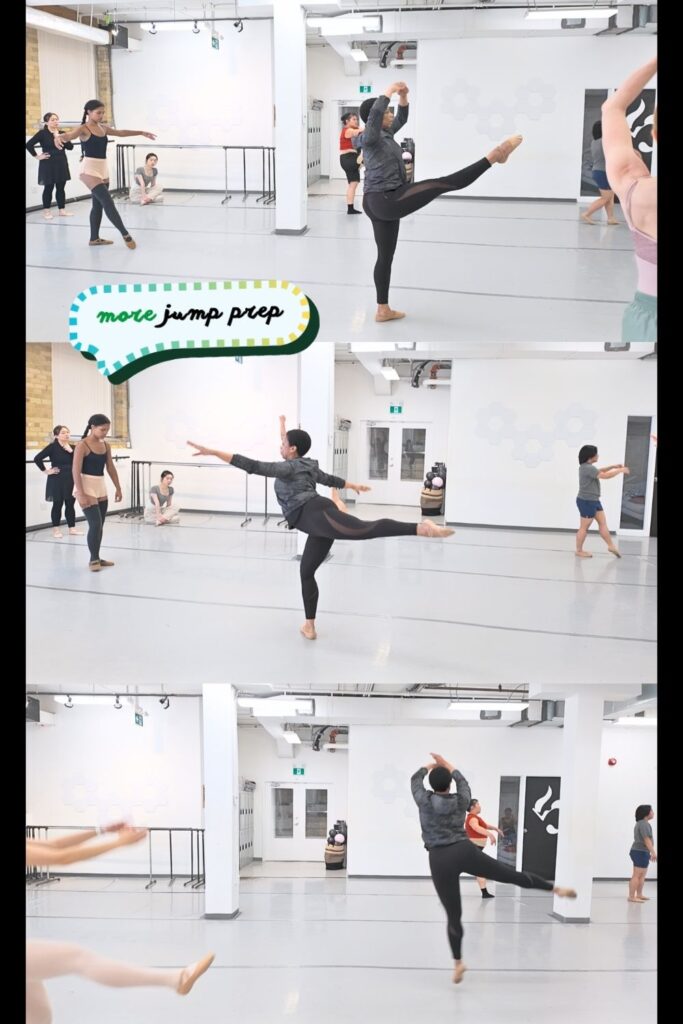
Below is a picture of me – a card carrying member of the old lady gang – leaping & cheesin’ through the air from a few weeks ago.
You can dance until you’re in the box. Don’t let anything stop you.

…and that’s time. Double pomodoro for this one (I’m rusty). Share your thoughts down below.
See you soon Luvlies!
xoxo Luv Laney Luv
*psst… Don’t forget to like and subscribe to my youtube channel and Patreon.
Morning Musing is a pomodoro-timed, free thought experiment to get back into the swing of things. No Ai added.